Insights
The
TEQM Reports.
Developmental insight that is precise, contextually grounded, and directly actionable.
Every TEQM assessment generates two complementary reports: an Individual Report for the participant and a Cohort Report for the organization. Together, they provide insight at both the individual and group level.
Designed to move beyond description alone, these reports provide the developmental insight needed to create targeted growth plans for individuals and more effective developmental interventions for teams and cohorts.
For Individuals
Your personal
development report.
A personalised report that interprets your results in context, identifies developmental priorities, and translates insight into an actionable developmental plan.
The individual report reflects the qualities visible in your responses and the developmental stage each one is currently expressing. It does not label identity, measure personality, or judge performance.
The results are interpreted in relation to the demands of your current role and context. From this perspective, the report highlights where development is already stable, where further attention may be beneficial, and the inner conditions most important for continued growth. Together, these insights provide a foundation for creating a focused and immediately actionable developmental plan.
These developmental stages reflect current patterns of expression and can evolve over time through experience, awareness, context, and deliberate practice.
Report Sections
About TEQM
Introduces TEQM and explains what it means to work with inner qualities.
Understanding Quality
Describes what qualities are, how developmental states work, and how qualities are organized into domains.
Your Developmental Lens
Explains the specific demands of your current context, clarifying the frame within which the most relevant qualities are identified, and shows how they are expressing themselves in relation to what the context calls for.
Your Results Snapshot
Provides a summary view of each of the assessed qualities, including the desired developmental level and your current developmental state.
Your Developmental Priorities
Identifies your current developmental priorities, and provides a detailed view of each of these qualities, including focused developmental interventions to help you strengthen the underlying conditions that support growth.
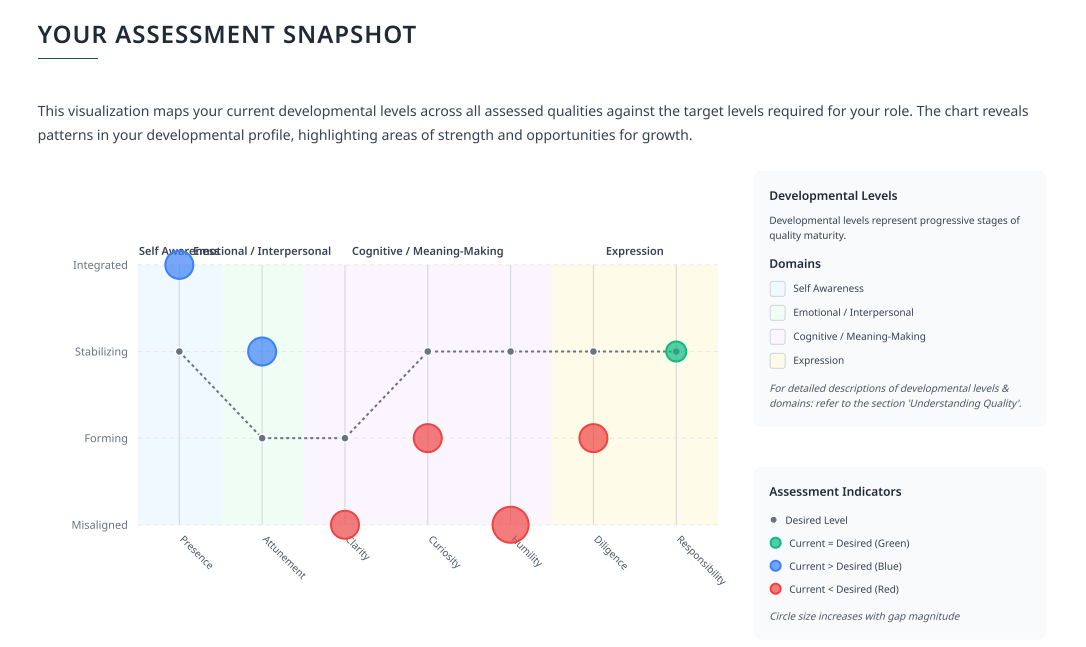
Your Results Snapshot
The visual maps your current developmental state across the five to seven qualities most relevant to your role and context, each assessed against the level that context currently demands. It highlights where capacities are already stable, where they are still forming, and where the gap between current expression and contextual demand is most significant.
Your Developmental Priorities
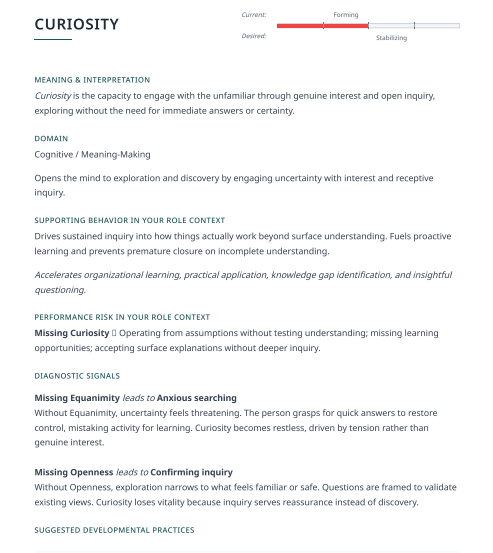
For each quality that requires attention, the report goes deeper. It identifies your current developmental state, defines the quality with precision, describes the behaviors it supports and the risks of its absence, surfaces diagnostic signals reflected in your responses, and provides focused practices designed to support growth from your current position.
Precise definitions anchor understanding. Diagnostic signals reveal the underlying patterns shaping expression. Focused practices provide direction for growth.
Together, these insights provide everything needed to build a focused and immediately actionable developmental plan.
For Organizations
Your cohort's
developmental report.
A cohort-level report reveals where your cohort stands, where development needs attention, and where institutional support will have the most impact.
The Cohort Report complements the Individual Report received by each participant. Where the individual report provides a personalised developmental view, the cohort report provides the organization with an aggregate picture of collective readiness.
It reveals shared developmental patterns across the group, the qualities where the cohort is strongest, and the priorities most important for supporting participants through their current transition. This gives organizations the clarity to design targeted developmental support where it will have the greatest impact.
Report Sections
Quality Distribution
Shows how participants are distributed relative to the desired developmental state for each quality, highlighting where collective development support may be most valuable. It also includes a domain alignment summary.
Participant Readiness Distribution
Two complementary views: the distribution of participants by number of developmental gaps, and the distribution of gaps by quality, showing which qualities account for most development needs across the cohort.
Cohort Analysis
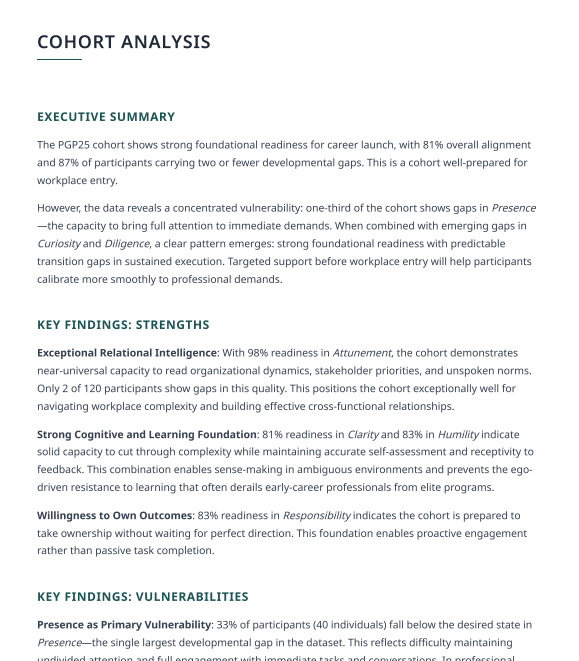
Practitioner-authored analysis translating assessment data into strategic insight, covering key findings, strategic implications, and recommended action priorities.
Assessment Data
Summary table displaying participant counts at each developmental state for every assessed quality.
Appendices
The report includes four appendices covering a brief overview of the TEQM framework, quality domains and developmental states, the operating context of the developmental lens, and the full quality set assessed for the cohort. Together, they ensure the report is fully self-contained and immediately actionable without requiring prior familiarity with TEQM.
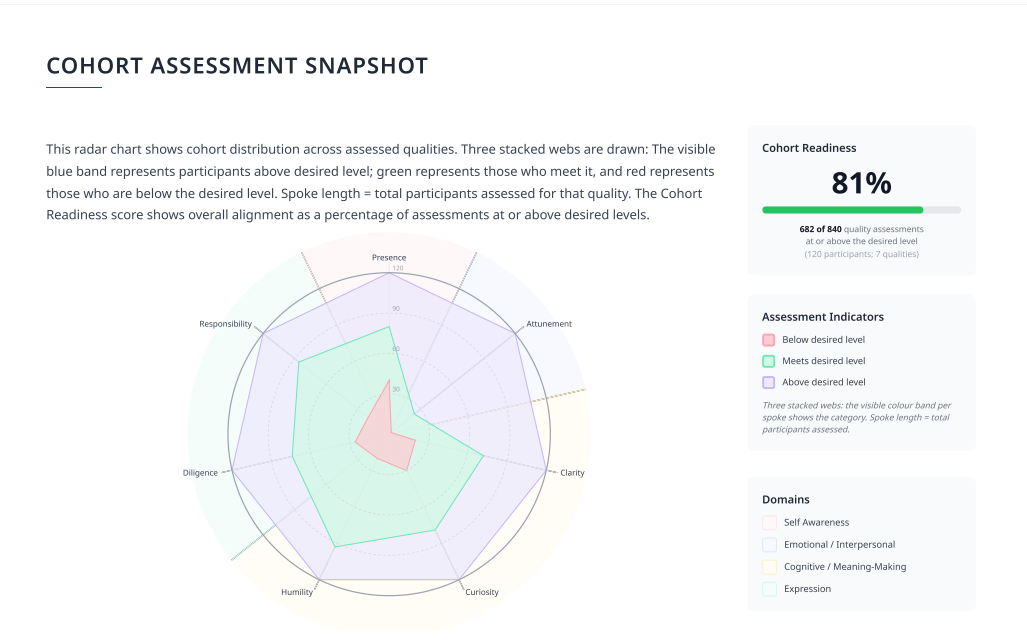
Cohort Assessment Snapshot
The radar chart maps the cohort's collective developmental profile across all assessed qualities, showing how participants are distributed relative to the desired developmental state for each one. The Cohort Readiness Score expresses overall alignment as a single percentage.
Read together, the chart and score provide an immediate view of where the cohort is strongest and where a meaningful growth opportunity exists.
This gives program leaders a clear starting point for deciding where developmental investment will have the greatest impact.
Quality Distribution
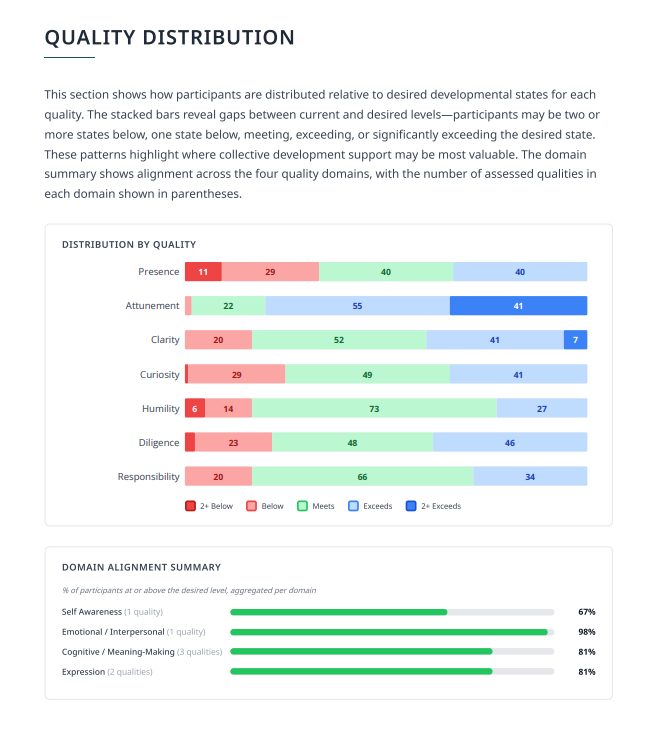
The stacked bar chart shows how participants are distributed relative to the desired developmental stage for each assessed quality. A domain alignment summary accompanies the chart, providing a consolidated view of readiness across the four developmental domains: Self-Awareness, Emotional and Interpersonal, Cognitive and Meaning-Making, and Expression.
Where the Cohort Assessment Snapshot provides the overall picture, this view reveals the detail beneath it, showing how the cohort is distributed across each quality and which domains are shaping overall readiness.
Together, these views help organizations identify where developmental investment will have the greatest collective impact.
Participant Readiness Distribution
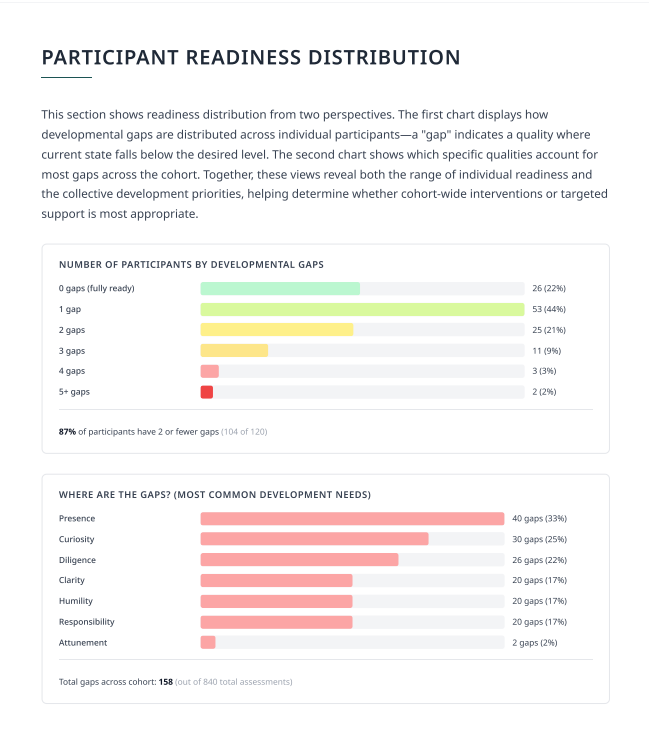
Two complementary views reveal the cohort's developmental readiness from different angles.
The first shows how developmental gaps are distributed across participants, indicating how many are fully ready, how many carry one or two gaps, and how many may require more focused support.
The second identifies which qualities account for most of the gaps across the cohort, highlighting where collective developmental effort will be most valuable.
Together, these views help organizations determine whether cohort-wide intervention is sufficient or whether more targeted support may be needed, giving program leaders the clarity to make those decisions with confidence.
Cohort Analysis
The Cohort Analysis is the interpretive core of the report, authored by a senior TEQM practitioner. It helps organizations understand what the assessment patterns mean and where developmental attention is likely to have the greatest impact.
The analysis covers the cohort's key developmental strengths alongside patterns of collective vulnerability revealed in the data. It explores the implications of these patterns for the cohort's current transition, and concludes with clear recommendations on where targeted developmental support will have the most impact.
For program leaders, it provides clear direction for targeted developmental interventions.