
For Institutes
Industry
Readiness Program.
A structured in-person developmental workshop for educational institutions preparing students for workplace readiness and professional careers.
The TEQM Industry Readiness Workshop addresses four critical dimensions of industry readiness: behavior and attitude, expectation setting, professionalism, and skill development, each as a distinct, focused session with clear objectives, outcomes, and actionable takeaways.
Delivered At
Workplace Readiness
Beyond skills and competencies.
Institutions committed to preparing students for professional success increasingly recognize that early-career effectiveness depends on more than academic achievement and technical capability.
Employers assess graduates on capacities that become visible quickly in the workplace: how they respond under pressure, receive feedback, adapt when expectations are unclear, collaborate across differences, and take ownership without constant direction.
These are the same behaviors placement teams hear about most often in employer feedback, long before technical performance enters the conversation.
As professional environments become faster-moving, more collaborative, and increasingly AI-enabled, these capacities gain even greater significance. While aspects of technical work are becoming easier to automate, human judgment, adaptability, relational intelligence, and grounded responsibility remain distinctly human.
Beyond Soft Skills
The program goes beyond workplace etiquette and conventional soft-skills training. It develops the inner qualities that shape how students think, feel, decide, and act across different professional situations.
These qualities have been selected based on research into what influences effectiveness during the early years of professional work and calibrated specifically to the transition from campus to the workplace.
By working at this foundational level, the program supports development that students can continue to apply as roles, expectations, and circumstances change. This developmental logic shapes the program's structure.
Explore the modelProgram Structure
Four sessions, covering behavior and attitude, expectation setting, professionalism, and skill development, are deliberately sequenced around a common spine. Each addresses a distinct aspect of the transition into professional life while building on what comes before, creating a progressive arc from self-awareness to professional agency.
It is this combination of focused sessions, an interconnected developmental design, and TEQM's foundational approach to human development that makes the program an effective developmental intervention.
The Four-Session Arc
The Industry Readiness Program.
The program is delivered as a four-session intervention, structured in two blocks of two sessions. Each session runs 60 minutes, for a total of four hours of session time plus breaks, delivered as a single extended day or split across two, depending on your institution's schedule. Sessions are interactive by design, not lecture-driven: each one moves between framing, reflection, discussion, and application.

 The program is co-facilitated by Kedar Lele, President of Haleon India Subcontinent and former Managing Director of Castrol India, and Dakshaka, an ISB alum and leadership and transformation practitioner with three decades across corporate leadership and organizational change.
1Behavior & Attitude
Who you are matters more than what you know
Help students understand the significance of behavior and attitude as they step into the workplace. How they show up often counts for as much as what they know, and in many situations, even more. This session helps students understand how their behaviors and attitudes are formed, and what it takes to shape them with intention. Students are armed with the self-awareness and intentionality to engage their careers well from day one, anchored in the right behaviors and attitudes.
Outcome: Students leave with an ability to name the gap between how they see themselves and how they're actually perceived, understanding that behavior and attitude are shaped from within by inner qualities, and carrying the intentionality to engage their careers accordingly from day one.
2Expectation Setting
The world you're entering
Help students develop a clear and grounded picture of what the workplace actually demands of them. The transition from campus to corporate is a significant shift, and students who understand what to expect are far better placed to make the most of it. This session helps students recognize where their assumptions may need adjusting, and what corporate roles truly ask of them beyond knowledge and technical skill. Students develop calibrated expectations and the clarity to meet the real demands of professional life.
Outcome: Students leave with a grounded, calibrated picture of what corporate roles actually demand beyond technical skill, and a clear understanding that it is their qualities that determine how well they meet those demands.
3Professionalism
How you will be seen
Help students understand what professionalism means in a corporate setting and why it matters. How they conduct themselves, communicate, and engage with others shapes their reputation and determines how far and how fast they grow. This session gives students a clear picture of what professional standards look like in practice, and what it takes to build a successful career on that foundation. The assessment is released at the close of this session, completed at each student's own pace before Session 4 begins.
Outcome: Students leave with an understanding of professionalism as it plays out in practice, across communication, relationships, and daily conduct, and as a conscious choice driven by the qualities they bring to every situation.
4Skill Development
How you will keep growing
Help students understand that skills can be developed, and that investing in that development consistently is what builds a lasting career. This session helps students identify their strengths and development areas, and equips them with a concrete plan to grow with intention and purpose. Students are able to take charge of their own development, from day one and beyond.
Outcome: Students leave with a clear read on their own developmental needs from their assessment results, and a concrete plan to grow the qualities that matter most for early-career success.
The Reports
From individual development to cohort readiness.
Each cohort generates two reports: an individual report for every student and a cohort-level report for the institution.
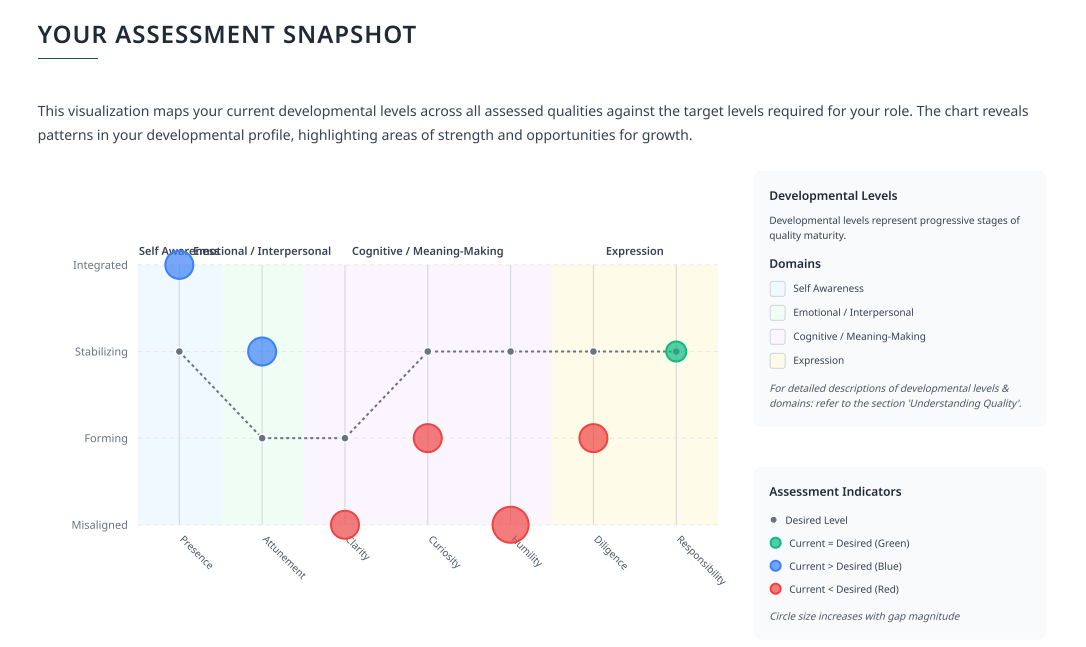
The individual report gives each student a precise developmental view of the qualities that are already well established, those that are still developing, and where to focus first. It also includes an individualized developmental plan to help translate insight into continued growth.
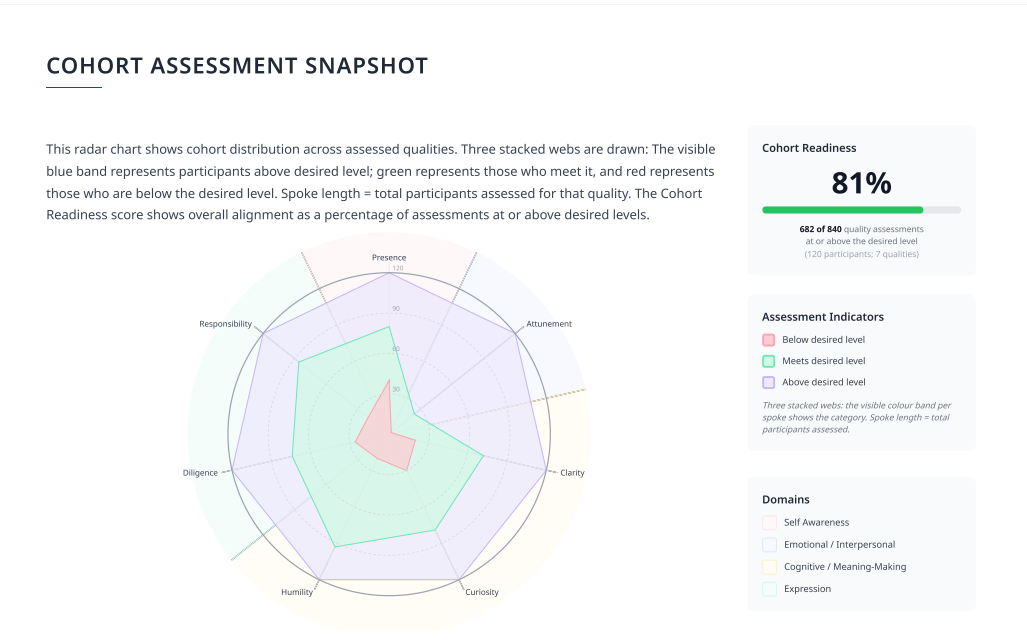
The cohort report provides the institution with an aggregate view of the group: an overall Cohort Readiness Score, a quality-by-quality distribution, and a practitioner-authored analysis identifying where collective developmental investment is likely to have the greatest impact. Delivered ahead of placement season, this becomes a diagnostic your institution can act on directly, sharpening where pre-placement preparation will matter most.
Both reports are explained section by section on our Reports page. If you would like to review the reporting experience in full before a scoping conversation, request a complete sample of both the individual and cohort reports.
Let's Talk
Start the
Conversation
If your institution is exploring how to better prepare students for the transition into professional life, we'd be glad to begin a conversation, on your cohort, your context, and what you're hoping to achieve.
Delivered At
What makes it worth arranging is what your students, and your institution, walk away with. Every student leaves with a personalised developmental plan, not a generic takeaway, and your Institutions receive a data-backed view as a cohort report that reveals shared patterns across the group and where developmental investment will have the greatest impact.
We'd be glad to walk you through all of this when we talk, the quality lens this program is built on, drawn from research into what actually determines early-career success, and the complete versions of both reports, the full cohort report and the full individual report, not just the samples shown above.
The engagement, end to end
Every engagement begins with a scoping conversation, where cohort size, scheduling, and the specific quality lens for your cohort are agreed directly with your institution.
Each batch accommodates up to approximately 150 students; larger cohorts run across multiple batches, scheduled to fit your institution's calendar. Program investment is scoped the same way: shaped by cohort size and delivery format, so you're not paying for a fixed package that doesn't fit your cohort.
On your end, all that's needed is an auditorium-style room with a projector, screen, and audio system, microphones recommended for larger venues.
Engagements can include an optional follow-up: a cohort check-in, typically three to six months later, bringing the group back together to share what's shifted, reinforce the qualities the program focused on, and open the floor to questions and discussion. This is scoped and priced separately from the core program.
FAQ