Rethinking Human Development
The Emergent
Quality Model.
Beyond competencies, skills, and behaviors, TEQM defines the inner architecture that enables sustained leadership effectiveness.
The Emergent Quality Model (TEQM) offers a foundational shift in how human development is understood and supported. Rather than prescribing behaviors or labeling traits, TEQM focuses on strengthening inner qualities such as clarity, humility, and courage, qualities that shape how people think, feel, decide, and act.
The Foundation
What is a quality?
Behavioral science has long described human capacity through Traits, States, or Behaviors. Each offers valuable insight, yet none fully explains how growth becomes self-sustaining across changing conditions and increasing complexity.
Qualities offer a fourth way to understand human capacity, one that connects inner coherence with outward expression. Clarity, humility, courage, adaptability, responsibility: these are not simply behaviors or temporary states, but enduring inner capacities that shape how a person thinks, feels, decides, and acts across situations and contexts.
Qualities emerge when specific foundational conditions align. Unlike habits, which are automatic, or states, which fade, qualities express themselves naturally through an integrated self. They are not performed behaviors, but coherent ways of being expressed in action.
A quality can be understood through a simple dynamic:
Quality × Context = Expression
The quality is the inner capacity. The context is the situation that calls it forward. Expression is the behavior that arises from their meeting.
Grounded in depth —
ancient and contemporary.
TEQM rests on a philosophical foundation that is both ancient and rigorously contemporary. Its roots lie in ancient Indian wisdom, which recognized that authentic expression emerges from inner stillness and coherence. This understanding finds strong resonance in modern behavioral science and developmental psychology.
Lisa Feldman Barrett demonstrates that experience and behavior are constructed in the moment from deeper internal processes.
Robert Kegan shows that growth involves transforming the underlying structures through which we make meaning of ourselves, others, and the world.
Daniel Siegel highlights integration across emotional, cognitive, and relational systems as central to psychological maturity.
The Growth Levers
How do
qualities develop?
Qualities do not arise from instruction or imposed behaviors. They emerge naturally when the inner conditions that support authentic expression are carefully cultivated.
Courage, for instance, becomes available when Acceptance, Presence, Humility, and Clarity are sufficiently developed and working in concert. TEQM refers to these as creator qualities.
→ Acceptance brings the willingness to meet reality as it is.
→ Presence brings undivided attention to what the moment requires.
→ Humility reduces ego-driven distortion.
→ Clarity brings orientation toward what truly matters.
When these conditions align, Courage no longer needs to be forced or performed. Instead, it emerges naturally as an expression of inner readiness.
Architecture of TEQM
An interconnected
map of 43 qualities.
TEQM's architecture emerged from tracing the natural relationships between qualities: how some enable others to arise, and how others deepen and stabilise what has already emerged. The result is a coherent map of 43 human qualities that reflects how growth actually unfolds in lived experience.
Three Arcs of Growth
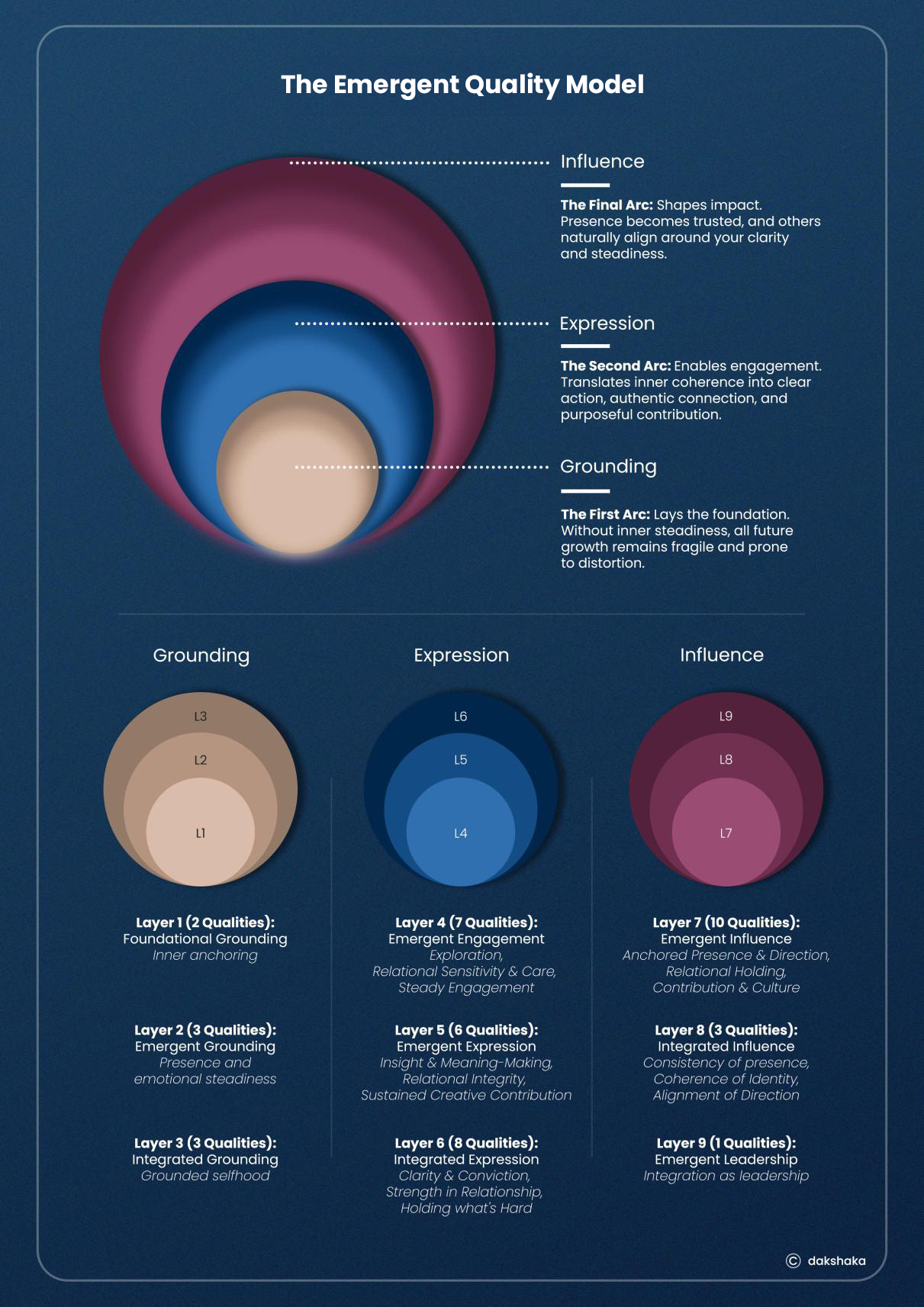
The 43 qualities organize into three arcs: Foundation, Engagement, and Influence. These arcs were not predetermined. They surfaced from the natural relationships between qualities.
Each arc contains three layers, marking zones of deepening readiness within that movement of growth.
Together, the three arcs are not sequential stages but movements within a single continuum, each drawing from and reinforcing the others throughout a life of growth.
The Foundation Arc
Builds the inner conditions that make authentic expression possible, strengthening self-awareness and emotional stability so the system can stay clear and responsive as life unfolds.
The Engagement Arc
Marks the shift from inner stability to outward movement. Understanding, emotion, and intention begin to translate into behavior that carries depth and alignment.
The Influence Arc
Represents the culmination of development, where coherence extends beyond the self. What was once personal stability and expression becomes guidance and impact.
Creator & Amplifier Qualities
TEQM identifies two distinct roles within this map. Creator qualities establish the conditions from which other qualities naturally arise. Amplifier qualities deepen and stabilise expression once it has emerged. By mapping these relationships across all 43 qualities, TEQM makes the inner dynamics of human development visible and practically navigable.
Four Domains
The 43 qualities are organized across four domains, spanning the full range of human experience. Together, they ensure development addresses the whole person: every dimension of what it means to think, feel, decide, and act.
Self-Awareness
Encompasses qualities that deepen connection with the inner self, the foundation from which all authentic action arises. Examples include Stillness, Presence, and Rootedness.
Emotional and Interpersonal
Reflects awareness opening into feeling and relationship, shaping how a person connects, responds, and engages with others. Examples include Equanimity, Empathy, and Compassion.
Cognitive and Meaning-Making
Turns awareness toward understanding, interpreting experience, recognising patterns, and bringing coherence to complexity. Examples include Clarity, Reflection, and Discernment.
Expression
Represents awareness in motion, translating what is felt and known into action, contribution, and influence. Examples include Courage, Integrity, and Leadership.
Applying TEQM
TEQM's architecture, while comprehensive, translates into practice with clarity, focus, and ease. Human beings are complex, and the 43 qualities reflect that complexity honestly. In practice, not all qualities demand equal attention at once. Development is most effective when contextualized, when the qualities most relevant to where a person or organization currently stands are brought into sharp focus. This is the principle behind a lens: a deliberately chosen configuration that makes the full architecture actionable, without sacrificing its depth.
Making Development Observable
From framework,
to application.
The architecture of TEQM is deeply interconnected, yet its application is deceptively simple.
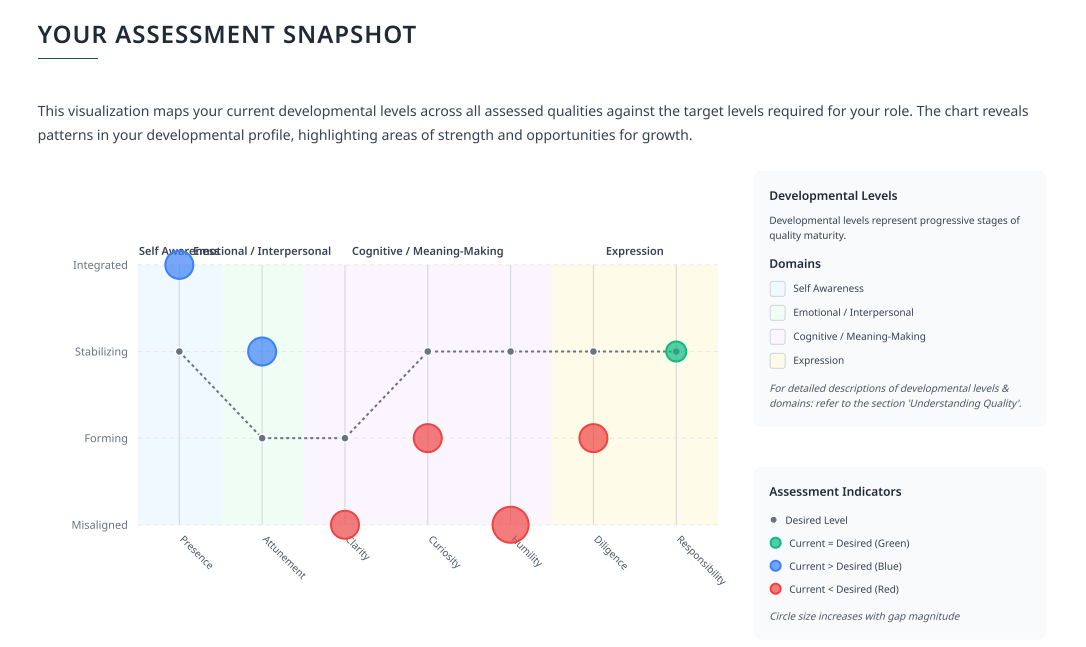
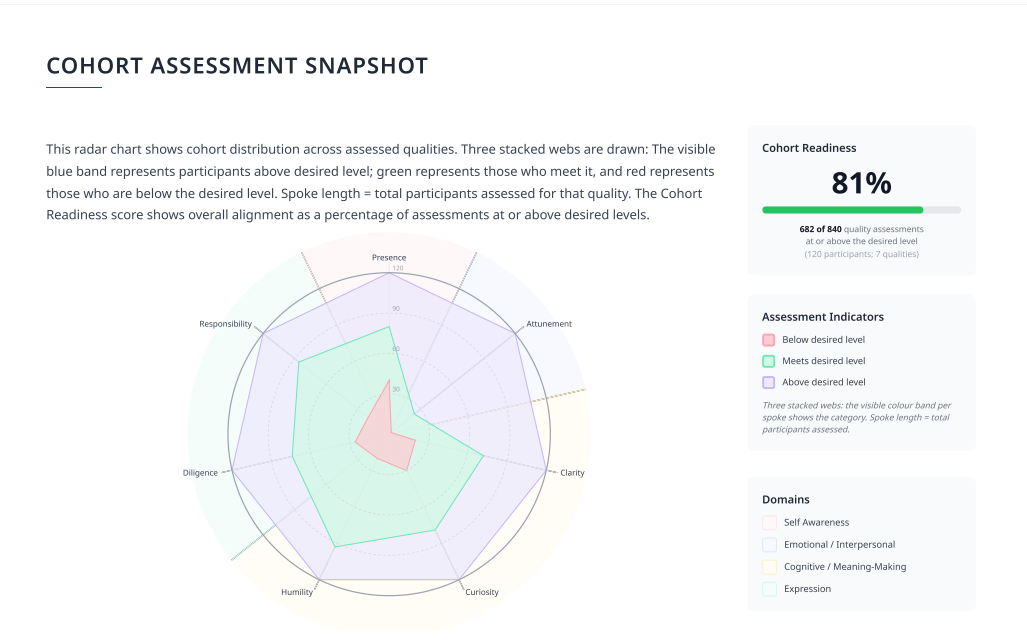
Rather than working with all 43 qualities at once, TEQM applies focused lenses, typically configurations of five to seven qualities most relevant to a specific role, transition, or developmental context.
These observations are interpreted through four stages of developmental expression: Misaligned, Forming, Stabilising, and Integrated. Together, they reveal both current expression and direction of growth without reducing capability to fixed labels or scores.
The result is developmental insight that is precise, contextually grounded, and directly actionable.