Career Launch.
A structured 3-hour in-person developmental workshop for institutions designed to strengthen student workplace readiness and early-career success.
Institutions committed to preparing students for professional success increasingly recognise that early-career effectiveness depends on more than academic achievement and technical capability.
Employers evaluate graduates on capacities that become visible quickly in the workplace: how they respond under pressure, receive feedback, adapt when expectations are unclear, collaborate across differences, and take ownership without constant direction.
As professional environments become increasingly fast-moving, collaborative, and AI-enabled, these capacities become even more significant. Technical capability is becoming easier to automate. Human judgement, adaptability, relational intelligence, and grounded responsibility are not.
Career Launch gives institutions a structured way to strengthen these capacities. It makes workplace readiness and early-career effectiveness visible at the level where they actually develop, while giving students the insight and developmental direction needed to grow before entering professional life.
The foundations of career launch.
TEQM's work with institutions and early-career cohorts has identified seven foundational qualities that shape workplace readiness and early professional effectiveness. Career Launch helps students identify developmental gaps and strengthen the qualities most important for successful transition into professional life.
The seven qualities of Attunement, Clarity, Curiosity, Diligence, Humility, Presence, and Responsibility form the developmental foundation of Career Launch.
Together, they shape how graduates engage with people, respond to feedback, navigate ambiguity, learn in unfamiliar environments, and build trust within professional settings.
When these qualities are present and developing, individuals adapt faster, earn trust earlier, and translate capability into consistent professional effectiveness.
When they are underdeveloped, even strong academic and technical capability often struggles to sustain workplace effectiveness.

Attunement
Attunement is the capacity to sense and respond to subtle cues in oneself, others, and the environment, enabling accurate, and timely connection.
Without it, interpersonal dynamics are misread, expectations become unclear, and trust weakens.
Clarity
Clarity is the capacity to cut through confusion and distraction to see what is essential and true, enabling focused understanding and decisive action.
Without it, priorities become confused, effort gets scattered across competing demands, and communication loses direction.

Curiosity
Curiosity is the capacity to engage with the unfamiliar through genuine interest and open inquiry, exploring without the need for immediate answers or certainty.
Without it, surface explanations get accepted too quickly, important context remains unexplored, and learning slows prematurely.

Diligence
Diligence is the capacity to apply steady, careful attention to detail and quality, completing work thoroughly and to a high standard regardless of pressure or haste.
Without it, quality becomes inconsistent, avoidable errors increase, and reliability weakens.

Humility
Humility is the capacity to hold an accurate self-assessment without ego inflation or deflation, recognizing both strengths and limits.
Without it, feedback becomes difficult to integrate, learning slows, and mistakes get defended rather than examined.

Presence
Presence is the capacity to be fully attentive and engaged in the current moment, bringing undivided awareness and genuine availability to what is happening now.
Without it, important details get missed, conversations are only partially absorbed, and work loses consistency and care.

Responsibility
Responsibility is the capacity to recognize what is yours to manage and to engage with it willingly, taking ownership of roles, decisions, and impact without external prompting.
Without it, ownership weakens, accountability becomes inconsistent, and growth remains dependent on external direction.
The TEQM
career launch
program.
Career Launch is a structured 3-hour in-person developmental workshop that helps students understand what drives professional effectiveness, recognise how these capacities currently express in real situations, and leave with a clear and actionable developmental plan.
The experience unfolds across three connected sessions.
The first session helps students recognise, through experience and reflection, the deeper qualities that shape workplace effectiveness and early professional success.
In the second session, students complete an online scenario-based assessment built around realistic workplace situations that reveal how these qualities currently express themselves across professional contexts.
The final session combines a deep exploration of the seven Career Launch qualities with guided interpretation of each student’s individual report, helping participants identify developmental priorities and build a clear, actionable direction for growth.
1Session 1
The workshop opens by helping students discover, through experience and reflection, that inner qualities shape how a person perceives, responds, and acts. Before any framework is introduced, students develop a direct understanding of how these qualities influence professional effectiveness.
From this foundation, the session moves into context: what organisations evaluate during hiring, what managers notice in the early stages of employment, and why the seven qualities at the heart of Career Launch consistently shape how graduates adapt, earn trust, and grow through increasing responsibility.
2Session 2: Assessment
At the close of Session 1, the assessment is enabled. Students work through 20 to 25 realistic workplace scenarios designed to observe how the seven qualities currently express through the choices they make across situations commonly encountered in early professional life.
Below is an example of the kind of situation they will encounter:
Three weeks ago, you committed to researching new software options for your department and presenting recommendations to your manager by today's date. You've gathered basic information about several platforms and have a general sense of their features and costs. Your manager is expecting your analysis this afternoon.
In this situation, you would most likely...
Students complete the assessment individually at their own pace and take a short break. Session 3 begins at a fixed time.
3Session 3
Students receive their individual reports at the start of the session. Before moving into personal results, the facilitators guide the group through a deeper exploration of the seven qualities, what each one means in practice, how it appears in real professional situations, and why its presence or absence shapes workplace effectiveness in meaningful ways.
With this foundation established, students turn to their own reports, recognising their developmental patterns with greater clarity and context. The session closes with each participant identifying developmental priorities and building a focused plan they can begin applying immediately.
Career Launch
If your institution is exploring how to better prepare students for successful transition into professional life, we would be glad to begin a conversation.
Please reach out to Dakshaka at dakshaka@teqm.in to discuss your cohort, context, and institutional goals.


Precise, personal,
and actionable insight.
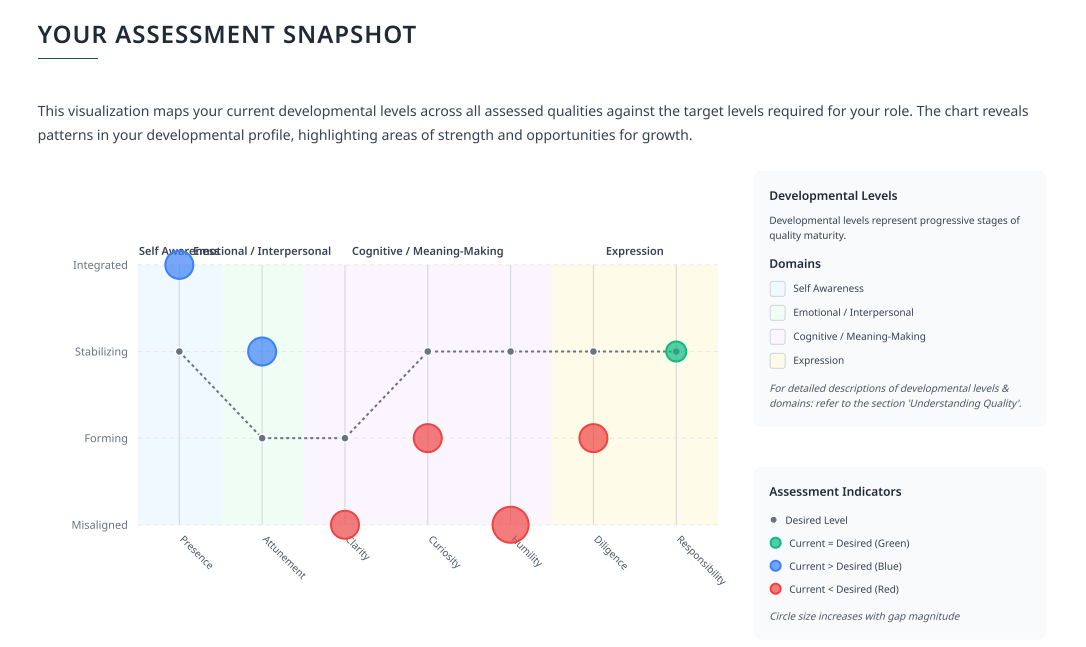
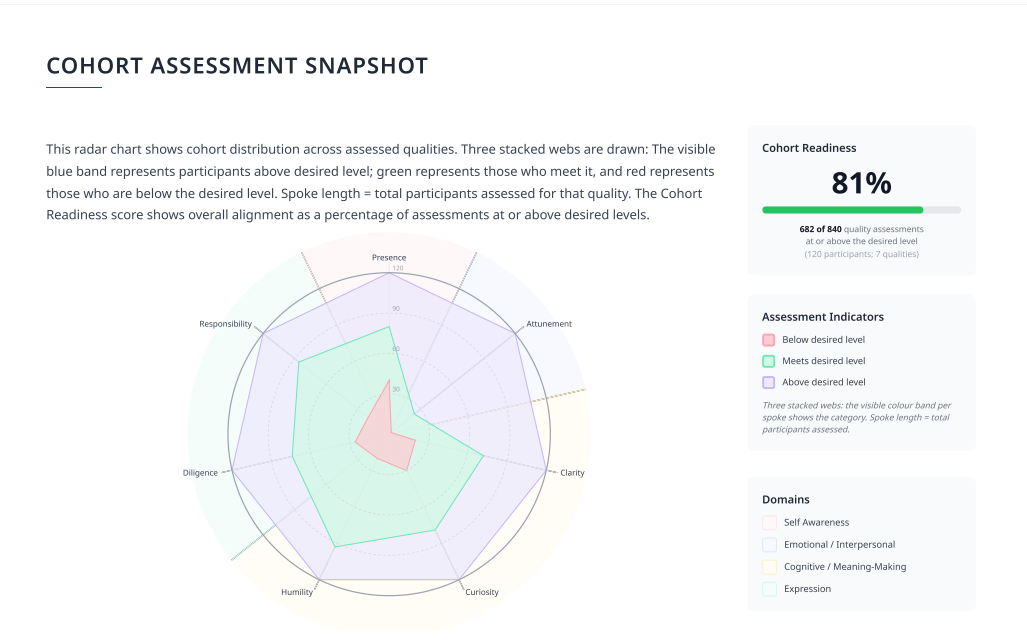
TEQM provides comprehensive developmental reports for individuals and organizations that make developmental patterns visible in ways that are precise, contextual, and actionable.
The reports combine developmental assessment with contextual interpretation and actionable insight, helping individuals and institutions understand where capabilities are already stable, where development is still emerging, and where focused attention may be most valuable.
Below are sample excerpts from the Individual Report and Cohort Report. The complete report structure and interpretive framework can be explored in detail on the Reports page.